Workshop in Traditional Metal Engraving – Chōkin
Traditional Japanese Craftsmanship of Kyoto
The Foundation for Contemporary Sacred Art – Sacred Art School of Florence presents an intensive workshop dedicated to traditional Japanese metal engraving (chōkin), one of the core techniques of Japanese sacred art and historic architecture.
This workshop offers students and professionals working in sacred art, metalwork, goldsmithing, and applied arts a rare opportunity to engage directly with a living craft tradition that has been practiced continuously for centuries and is still employed today in the creation and restoration of temples, shrines, and nationally protected cultural heritage.
The workshop is organized in collaboration with:
Shimada Chōkin Kōbō
Wakabayashi Butsugu Seisakusho
Firenze Kyoto Club
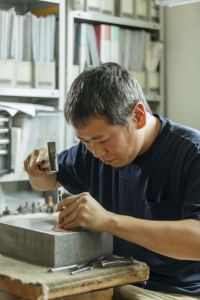
Master Traditional Metal Engraver (Chōkin-shi)
Born in Kyoto in 1978, Masaki Shimada is a master metal engraver specializing in the creation and restoration of decorative kanagu fittings for temples, shrines, and historic architecture.
He began his training in 1996 under the guidance of his father, Kenzaburō Shimada, entering the family workshop Shimada Chōkin. In 2010, the workshop was renamed Shimada Chōkin Kōbō “Miyabi”, with Masaki Shimada becoming its representative and third-generation master.
In 2020, he was officially recognized as a Traditional Master Craftsman (Dentō Kōgeishi) in the field of Kyoto Buddhist metal fittings. In 2023, he received the prestigious title of “Future Master” of Kyoto’s Traditional Industries, awarded to artisans entrusted with preserving and renewing traditional techniques.
His work includes commissions for major cultural sites such as Nagoya Castle, Nijō Castle, Ise Grand Shrine (Shikinen Sengū), the Gion Matsuri festival floats, and Kasuga Taisha Shrine, as well as numerous National Treasures and Important Cultural Properties.
Decorative kanagu are metal fittings that serve both ornamental and protective functions. They are applied to columns, doors, beams, roofs, Buddhist altars, and ritual objects within temples, shrines, and historic buildings.
Typically made of copper or brass, these elements are finished using traditional techniques such as mercury gilding, metal leaf application, patination, and electroplating. Kanagu are an essential component of the visual language and symbolic system of Japanese sacred architecture.
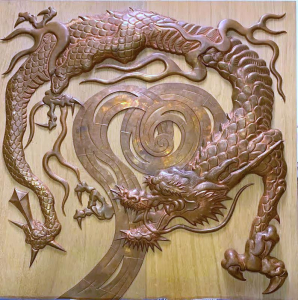
Chōkin is a fundamental Japanese metalworking technique involving the direct engraving of decorative motifs onto metal surfaces using hand-forged chisels (tagane) and a hammer.
In the production of architectural kanagu, each piece is made entirely by hand, starting from a flat metal sheet (copper, brass, gold, or silver). The design is engraved with extreme precision through controlled manual strikes.
Takabori – relief engraving
Kebori – fine-line engraving
Keribori – dynamic engraving with angled strokes
Katakiribori – single-edge cut engraving
Sukashibori – openwork engraving
Nanako-bori – background punching with small spherical dots
These techniques have been transmitted continuously since the 4th century and form the technical and aesthetic foundation of Japanese sacred metalwork.
The workshop aims to:
introduce participants to traditional Japanese metal engraving techniques
encourage dialogue between Eastern and Western sacred art traditions
expand students’ expressive and technical vocabulary
foster reflection on the role of traditional craftsmanship in contemporary sacred art
Study of figurative and geometric motifs, their symbolic meanings, and their historical and geographical context.
Practical introduction to the Keribori technique and the process of transferring designs onto a copper plate.
Application of the Nanako-bori technique to enhance engraved motifs through textured backgrounds, with particular attention to precision and regularity.
Participants will experiment with one or two traditional engraving techniques through guided hands-on practice. Visual materials will also be provided, including traditional designs, technical references, and examples of architectural and ritual applications.
The course will be activated with a minimum of 5 registrations.